
WEEKEND READING: Part Two: From loneliness to belonging: what can universities actually do?
This blog was kindly authored by Dr David Gilani, Head of Access and Participation, Middlesex University and Dr Michelle Morgan, Dean of Students, University of East London.
Pre-arrival Academic Questionnaire Pilot data, drawn from over 7,800 new students across fifteen English institutions, confirmed what many of us working in higher education have long suspected: transitioning into university leaves many students reporting frequent loneliness.
Following on from our first blog, which explored how loneliness on entry varies across domicile, sex, age, disability, ethnicity, prior school attendance and care and estrangement status, this blog turns to what universities can do about it. And just as importantly, what should we be careful not to get wrong? Here are five assumptions about loneliness and belonging that the sector is at risk of making, and five practical steps that institutions can take that mitigate these risks.
Risk one – assuming that loneliness is a failure
Feeling some level of loneliness, especially during a time of significant change to one’s life, identity and social relationships, is completely normal. As Dr Gareth Hughes puts it when talking about overcoming loneliness at university , ‘loneliness is a normal human response to the absence of something we need, like feeling hungry when we need food’. It is a warning sign that we need to act to improve our social connections, rather than a sign that something is broken. The scale of what part one found reinforces this: across the pilot, feeling lonely was consistently the most cited experience under the ‘often’ response, and it showed up across every student characteristic we looked at. Students who report feeling lonely before they have even arrived are experiencing the predictable consequence of a significant social transition, not a personal failing.
This matters because of how institutions tend to respond to loneliness data. The instinct is often to treat it as a problem to be solved, but this can lead to interventions that stigmatise further: inadvertently signalling to students that feeling lonely means they were not cut out for university. A student who still feels disconnected in week six may conclude that the problem is with them.
Jim Dickinson has argued persuasively on Wonkhe that many institutional approaches to belonging risk getting the social psychology the wrong way around – focusing on deficits in particular student groups rather than on the conditions that make connection normal for everyone. The loneliness data reinforces the importance of that distinction. The goal is not to fix lonely students. It is to build the scaffolding within which students can act to connect i.e. creating the conditions that enable an individual to actively get involved and engage with the school, community or culture.
Risk two – assuming that belonging is a destination
One of the consistent findings in the research literature is that belonging is not like a light switch that you flick on or off. It fluctuates, constantly changing over time. It operates differently at different points in the year and across different aspects of a student’s life and identity – their course, their campus, their friendships, their home community, etc.
This creates a timing problem. Students arrive lonely and so institutions respond with a burst of front-loaded support: welcome events, induction programmes, peer mentoring, academic support interventions. However then, broadly speaking as term progresses, these supportive structures dissipate.
Longitudinal research on belonging is still under-utilised, but the studies that track it over time tend to find belonging decreasing as the first-year progresses. A student who looks fine in a week-four survey may be in a very different place by January. If we front-load everything into establishing belonging early and then forget the rest of the journey, we miss the students who need support at exactly the moment we have stopped paying attention.
This matters more given the changing profile of the student body. Students coming through clearing or different entry points throughout the year; non-UK students who miss early induction due to visa and travel delays; those with work and caring responsibilities; and younger undergraduates navigating the transition for the first time all have most to lose when belonging work is front-loaded into the opening weeks.
Risk three – assuming that one source of connection addresses all loneliness
Recent analysis from Wonkhe of over 18,000 students across the UK found that over four in ten students who report a strong sense of belonging are also frequently lonely. However, a single measure of loneliness, or of belonging, will not capture the full picture, because students report many different aspects of connection and disconnection at once.
This maps onto a distinction that loneliness researchers draw between social loneliness (the absence of a broader network or group to belong to) and emotional loneliness (the absence of close individual attachments). A student who arrives lonely but quickly finds a flatmate or friends through a student society may have addressed some of what was making them feel lonely. But they may still feel that something is missing if they have not found connection within their course of study – the relationships that make classes, assessments and the route towards a discipline-relevant career feel accessible. The Wonkhe report calls this ‘academic citizenship’: the sense of knowing how to navigate your programme, feeling confident about where your studies are heading, and feeling free to speak in seminars. Students who have only made friends outside their subject area can show up fine on some belonging measures, while their career confidence and willingness to participate academically are often lower.
Risk four – assuming that our governance structures are fit for all students’ needs
Part one showed that among care-experienced undergraduates, over half (50.7%) reported lacking companionship at least some of the time, compared to 38.2% of their peers. Estranged undergraduates were more than twice as likely to report often feeling lonely (22.2%) compared to non-estranged students (13.4%). This is consistent with the Unite Foundation’s deep dive into the academic experience of estranged and care-experienced students.
Universities know this, and there has been notable progress from institutions and sector charities alike, from bursaries and funded accommodation through the Unite Foundation to the growing number of institutions signing up to charter-marks like the Care Leavers Covenant.
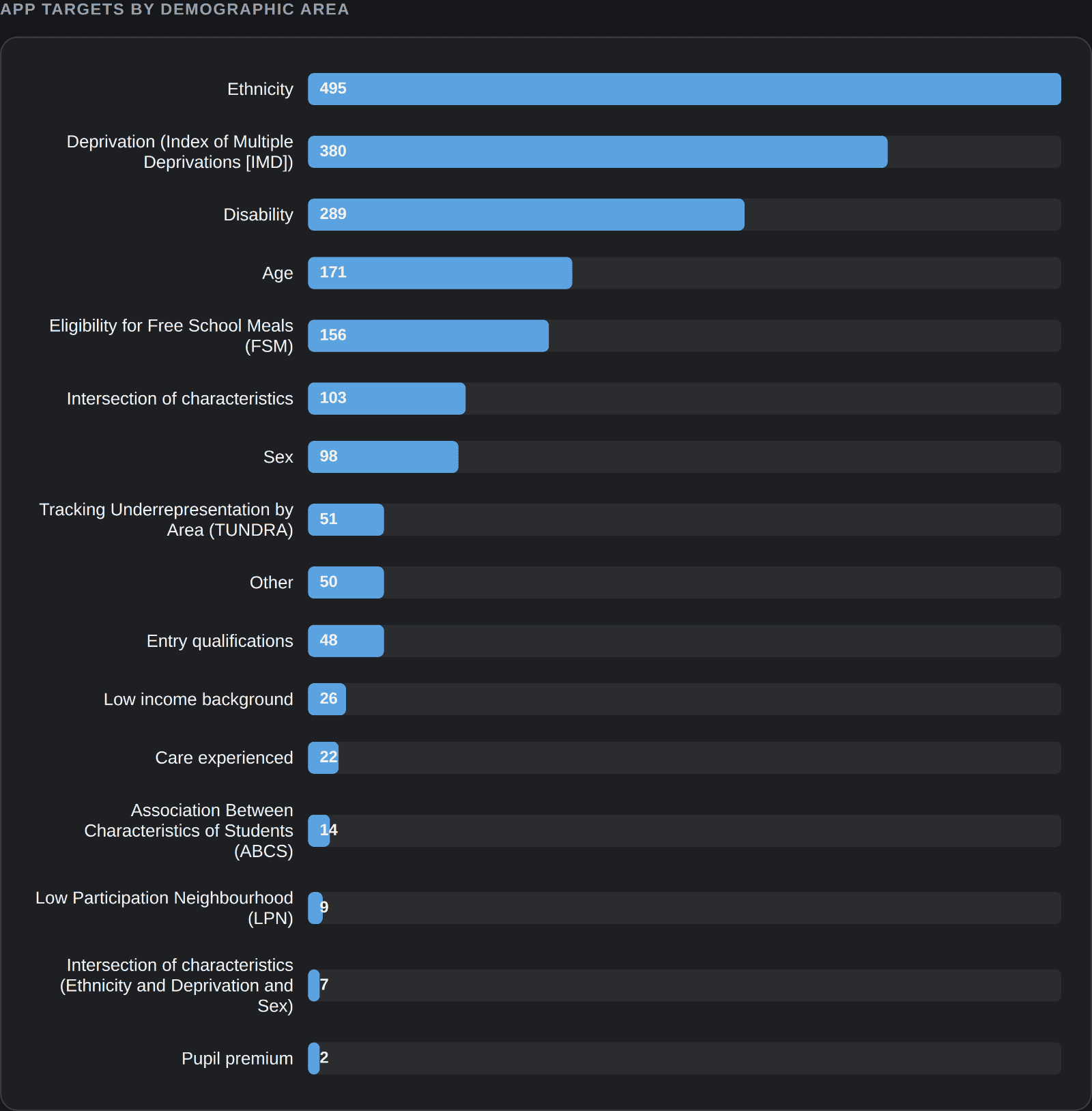
However, while there is greater provision and action to support care-experienced students, the vast majority of institutions do not have formal targets for these students, often because numbers are too small to have found significant differences in outcomes. Analysis of access and participation plans across England finds only 22 targets focused specifically on care-experienced students (Figure 1). The risk here is therefore that institutions, and the sector, are not set up to track whether all this action is actually leading to improvements in access, success and progression for care-experienced students.
Risk five – assuming that we need to wait until ‘induction’ to address student loneliness
The inverse relationship between prior school attendance and pre-arrival loneliness is one of the most striking findings that we discussed in our first blog on the pre-arrival loneliness data. What’s most troubling is that the number of school children classed as severely absent from school has been rising since the pandemic – with 150,000 now meeting that threshold.
Universities cannot solve school attendance directly, but we can indirectly through our outreach work and activities. At its best, these efforts help to create a clearer link for young people between staying in education and realising the future that they want. In the recent ‘From the Boys’ project at Middlesex University, listening to the experiences and perspectives of teenage boys in North London schools has highlighted how many do not see education as connected to how they define success.
If that belief is shaping attendance decisions, and attendance is shaping the loneliness that students feel in the transition to university, then access and outreach work that addresses those motivational questions is doing belonging work before students even set foot on campus. Alex Blower’s Boys Impact group has been developing practical approaches to this nationally, and it is worth universities asking whether their outreach strategies appropriately consider improved attendance (either as an end in itself or a means to improved student wellbeing later in students’ educational journey).
It is worth noting that the higher pre-arrival loneliness in part one was reported by female rather than male undergraduates, a reminder that single demographic binaries can hide a lot even where the national access picture points the other way.
So, what can universities actually do?
Part one of this blog clearly established that loneliness is pervasive on entry into higher education, and at risk of increasing given the links with school absence. Hopefully, from reading the risks above, colleagues will have ideas of how these can be mitigated and flipped into different approaches to address student loneliness and build belonging. Below is a summary of five suggestions that can assist with this:
1. Treat outreach as belonging work
Pre-arrival loneliness tracks with prior school attendance, which tells us the belonging journey starts well before enrolment. Outreach that builds credible connections between education and young people’s own aspirations is doing preventive work, but only if it listens to how pupils themselves define success rather than assuming that definition for them.
2. Plan for transition points after the initial induction period
Universities and students’ unions are generally good at inclusive welcome approaches, but these are front-loaded and rarely matched by plans for when students move between modules, accommodation and academic years. The students who most need support are often those for whom welcome and orientation never lands, because they arrived through clearing, missed early weeks due to visa delays, or were managing caring responsibilities. Extend welcome beyond the first week and create a full programme of induction to study (across the first term), and put similar support around later transition points where the risk of loneliness rises again.
3. Invest in subject-level community, together with your students’ union
Community-building tends to be organised around the institution, through big events and campus-wide societies. But the evidence suggests the unit that matters most for academic belonging is the subject discipline, and that is where universities and students’ unions need to work together. Plenty of lessons to be learned here from our continental European counterparts.
4. Measure belonging and connection in more than one way
A single survey, whether pre-arrival or at week four, will miss both the belonging dip that comes later in the first year and the four in ten students who say they belong while still feeling frequently lonely. Distinguishing social from emotional loneliness, and academic citizenship from social belonging, gives a more honest picture, which means being comfortable with data from multiple sources that sometimes tell conflicting stories.
5. Fill the gaps in formal accountability mechanisms and targets
The sector knows the barriers faced by care-experienced and estranged students and is making progress, but formal reporting takes time to catch up. Only 22 formal targets across Access and Participation Plans relate to these groups. Institutions that develop their own updated targets have a better chance of measuring whether their support is actually working.
The two blogs on loneliness have hopefully been informative and provided insight and practical advice on how we can normalise integrated support for something that is normal.





Comments
Add comment