
WEEKEND READING: Research may lose money. Cutting it could lose universities even more
This blog was kindly authored by Professor Tim Jay, Associate Pro-Vice-Chancelor for Research and Knowedge Exchange, Professor Martin Jensen, Professor in Economics and Paula Gurteen, Head of Research and Knowledge Exchange, Faculty of Social Sciences, all of the University of Nottingham.
There is an obvious response when an activity does not cover its costs: do less of it. For UK universities under acute financial pressure, research increasingly appears to fit that description.
UKRI’s data pack on the financial sustainability of research puts the sector-wide research deficit at £6.18bn in 2023-24, up from £5.62bn the previous year. Only 66.6 per cent of the full economic cost of research was recovered, down from 69.3 per cent. The main source that universities draw on to subsidise the costs of research is non-publicly-funded teaching – primarily international student fees. The Office for Students’ latest assessment agrees; although financial sustainability across the higher education sector improved modestly in 2024–25, much of the improvement came from tuition-fee income, and forecasts of future recovery remain heavily dependent on international student recruitment growth.
That subsidy model is now under strain from both directions. Research costs are not being met, while international recruitment has become more volatile. Chris Husbands’ recent HEPI report describes structural underfunding of research, domestic teaching pressures and international volatility as three worsening elements of the same financial problem. Meanwhile, Universities UK and ARMA report that 19 per cent of surveyed universities have already reduced some academic research activity, while 79 per cent were considering doing so in future.
So research portfolios must be scrutinised. But the usual financial lens – grant income, overhead recovery and direct cost – captures only part of research’s institutional value. If research quality contributes to reputation and student demand, a cut that improves a faculty’s short-term cost position may weaken the income base of the wider university. The crucial complication that we present here is that this relationship may not look the same in every discipline.
Different disciplines speak differently to the market
Our analysis of Nottingham and 15 comparator research-intensive universities1 examined five broad disciplinary clusters: engineering, medicine and health, science, social sciences, and arts and humanities. We compared two dimensions of research performance – external research income and publication quality, measured through REF 2021 output GPA – with international undergraduate and postgraduate recruitment, measured as numbers of registrations. The results identify associations, not causal effects, but the patterns in the data are striking.
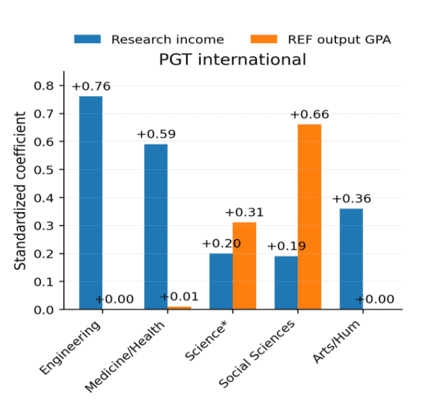
Standardised coefficients from models including both external research income and REF output GPA. The results show that international postgraduate recruitment is more strongly associated with research-income strength in engineering and medicine and health, but with REF-assessed output quality in social sciences.
In engineering and medicine and health, international student recruitment is most strongly associated with the scale of external research income – in engineering, for example, the correlation between external research income and international PGT registrations is .76, while the correlation between REF output GPA and international PGTs is only .04. Within these discipline clusters, the scale of externally funded research may yield more visible signals of high-quality facilities, industrial connections, scientific activity and institutional capacity, which act as a draw for international students.
The social sciences work differently. International postgraduate recruitment is strongly associated with REF output quality, with a correlation of .70, but much less strongly with external research income, with a correlation of .33. A broadly similar disciplinary contrast appears for international undergraduate recruitment: REF-assessed output quality remains particularly important in social sciences, while research-income strength is more prominent in several other disciplinary clusters.
When we look at QS academic reputation data, the same broad pattern appears – in engineering and in medicine and health, QS academic reputation is more closely aligned with external research income. In the social sciences, it is more closely aligned with REF output GPA. This relationship with QS academic reputation may help explain some of the association between research metrics and international student recruitment, as we know that international students attend to QS rankings. Our analysis cannot establish the direction of causation or isolate the precise mechanism. However, the alignment with QS academic reputation reinforces the conclusion that research, reputation and international student recruitment should be treated as an interconnected system rather than assessed independently.
The other clusters – science, and arts and humanities – do not appear to follow simple rules. In science, publication quality and research income are more highly correlated than in other areas – the correlation between REF Output GPA and log research income is 0.58 in science disciplines while it is 0.14 and 0.21 in engineering and social sciences, respectively. In arts and humanities, research income appears to capture the scale and visibility of internationally recruitable portfolios such as media, communications and creative disciplines, but, in other arts disciplines, the relationship between research income and international student recruitment is less strong. But again, the details of the differences do not affect the central message here, that any single institutional proxy for research value will likely misread and misvalue important parts of the portfolio.
The danger of cutting what the accounts cannot see
For social sciences, our analysis suggests that publication excellence may therefore have a commercial value to universities that conventional models do not show. Our modelling of 16 research-intensive universities illustrates the potential scale. Moving one place up the social sciences rankings by REF output GPA is associated with around £13m more annual gross international fee income across postgraduate and undergraduate. This is not a forecast or proof that a REF improvement causes recruitment: the estimate is modelled from a small comparator group and will differ by institution. But the correlation is large enough to demand consideration in strategic decisions.
A narrow assessment might classify a social science unit with modest grant income as less valuable than a laboratory-based unit with a large external portfolio. Yet if publication quality sustains subject reputation, and subject reputation supports international student demand, reducing research time or critical mass in that unit may damage one of the key income streams being used to underpin the financial sustainability of the institution.
The effects will not be immediate. Reputation accumulates slowly, international recruitment responds with a lag, and the damage may become visible only after staff have left, doctoral communities have thinned and publication pipelines have weakened. By then, rebuilding capability is expensive and uncertain. Short-term savings may create a long-term revenue risk.
From one research model to a portfolio of models
Universities cannot conclude that every existing area of research must be protected. The sustainability gap is real, and selectivity is unavoidable. But the implication of the analyses we have shared here is that institutions need to consider different business models for research activity in different parts of the university.
In some disciplines, external research income, cost recovery, infrastructure utilisation and partnership scale will be central to the model. In others – especially social sciences, based on our modelling – publication quality, academic reputation, and international student recruitment should be treated as connected components of value. The House of Commons Education Committee has similarly concluded that financial pressures, research funding and international recruitment are inextricably connected, and that uncoordinated institutional decisions risk decline.
This points to three practical recommendations for universities. First, governing bodies should require research portfolio decisions to include downstream recruitment and reputation risks, not only immediate savings. Second, finance, research and student recruitment data should be brought together at discipline level; university-wide averages conceal the relationships leaders need to understand. Third, proposed reductions should be stress-tested over several recruitment cycles.
The sector cannot cross-subsidise research indefinitely on its current terms, and government and funders still need to address the underlying failure of cost recovery. But universities should avoid treating all research as the same kind of financial problem. In social sciences, cutting research quality may not merely reduce an institutional cost. It may also erode the reputation that attracts international students and, with it, part of the income on which the whole university depends.
1Birmingham; Bristol; Cardiff; Durham; Exeter; Leeds; Liverpool; Loughborough; Manchester; Newcastle; Nottingham; QMUL; Sheffield; Southampton; Warwick; York





Comments
Jonathan Alltimes says:
I I agree the situation is complicated, but the overall choices are simple. The analysis assumes there is more choice than appears, as revealed by the variation in the association among research, reputation, and recruitment for different degree subjects. The causal model is, research outputs causes institutional reputation which causes postgraduate recruitment in a differentiated way for each subject. Let us assume the model is at least partly true. Can an institution afford to continue to fund research if the revenue can not exceed the costs? More recruitment can not solve the cost side of the balance sheet, even if cash flows exceed investment costs over time. The institution must accumulate at scale a cash surplus more than al of its full economic costs in order for it to be more than a going concern. Nearly all academic institutions have been divesting from most teaching work which does not contribute a cash surplus, for example, redundancies. Note, the criterion here is not the profit motive, but the sustainability of the academic institution being more than a going concern. The cost and margin calculations must be performed first, before including ideas about research and reputation risks controlling student recruitment at some undefined future, as the timeframe is one accounting year. Assuming it has a cost accounting system, if an academic institution looks at its forecast for year end and sees it is not a going concern, it will be obliged to cut costs and raise revenues. It can not afford to fund future research, if it does not exist next year. The subject-specific business model does not matter and neither do the three recommendations, as the imperative is the OfS reporting requirement of being a going concern. The academics institutions do not have the time the authors think they have to stretch out the finances for controlling the determinants of costs and revenues of research, reputation, and recruitment, largely outside of their control and unknown likelihood of causal effect, year after year after year (practically no institutions have sufficient cash reserves beyond a year). Institutions need to get on with specialising and stop paying for research with under-recovered and unforeseen costs. Institutions need to plan an orderly exit from research projects and research programmes for researchers, which is different for each institution and subject. We need large scale sector-specific research institutes, whose costs are fully covered by the £8.8bn UKRI budget.
Reply
Add comment